 |
Sunday, September 12, 2010

Saturday, September 11, 2010
Defying the Laws of Physics
 |
| Arnac Le Brela |
Today I learned what a pooptagon is. Do you know? Apparently, according to my twins, a pooptagon is a poop in the shape of a letter, commonly the letter J I've been told. If the poop has been stepped on, it is no longer a pooptagon.
The burning question. How does a pooptagon defy Newtonian physics? According to my twins a pooptagon has no sides. I find that fascinating.
Editorial note: Okay, I can't help but editorialize. This is actually a great learning demonstration for my twins. They obviously have been learning about shapes, which is geometry, something I learned as a sophomore in high school, and they made it into a game demonstrating first that they understand what a shape is and that it has sides. And then they thought it would be funny to have a shape with no sides, defying the rules they learned for other shapes. I know part of this grows out of a conversation they had with their grandfather about circles having only one side. They had guessed it had no sides (smartly I might add (assume?) because they deduced it had no sides because it had no corners -- a logical extension of an assumption about sides and corners). Kids are smart and encouraging them only makes them smarter, more playful, and generally fun to be around. And I'll never be able to look in a toilet the same way again.
Thursday, September 9, 2010
2. Work for Improvement, Not Perfection
Part two of Encouraging our Children is work for improvement, not perfection. In this entry, Schafer argues that parents need to reconceptualize how they encourage childrens' achievements. I must admit that this one seems a bit touchy-feely to me. I am a perpetually frustrated perfectionist and I generally have high expectations for others, including my children.
But I don't think Schafer is really saying parents should lower their expectations, or at least I hope not. No. I think she is saying parents should take a different approach to how we encourage our children to achieve the best they can. And she has some simple advice for doing it. Essentially her advice is to encourage what the child has done, rather than what he hasn't done and to encourage the child to do more within reason. It reminds me of Vygotsky's zone of proximal development in which the parent or teacher pushes the child or student just beyond their understanding, but not so far as to stifle any learning. Of course, it's more complex than that, but it makes sense to me as a parent and a teacher.
On a more practical level, I like to use the example of climbing a mountain. If one looks to the top of the mountain from the bottom, it looks daunting -- enough so that a novice hiker might quit. But, if the hiker simply keeps her eye on the trail a few feet in front of her (e.g. a reasonable distance to climb), she will find herself on the summit before she knows it. This has certainly been the case for me when I've biked up steep hills.
So with my boys I am going to try to remember to encourage what they have done and not to correct or fix what they have haven't done or done well, especially when it involves something with the rest of the family, such as cooking. I am going to try to offer jobs to my boys that push their skills, even though it may mean the food isn't perfect or they make a bigger mess, so they can learn by experimentation with cooking as well as developing their fine motor skills.
This morning, before I had even reviewed Schafer's book (writes a proud father), I was working with Twin M. on making and freezing sausage patties. It became a great lesson in freezing and cooking. First, we discussed why we flatten the patties, why we want them thin (they cook faster), and why it is important to be careful with them so they freeze flat. Then Twin M. got to practice flattening patties and placing them gently in a freezer bag. (Full disclosure: I did "perfect" some of his patties by flattening them a bit more -- shame on me.) He was happy to help prep for one of his favorite foods and I was happy to have the focused help. Hopefully there will be lots more moments like that one.
But I don't think Schafer is really saying parents should lower their expectations, or at least I hope not. No. I think she is saying parents should take a different approach to how we encourage our children to achieve the best they can. And she has some simple advice for doing it. Essentially her advice is to encourage what the child has done, rather than what he hasn't done and to encourage the child to do more within reason. It reminds me of Vygotsky's zone of proximal development in which the parent or teacher pushes the child or student just beyond their understanding, but not so far as to stifle any learning. Of course, it's more complex than that, but it makes sense to me as a parent and a teacher.
On a more practical level, I like to use the example of climbing a mountain. If one looks to the top of the mountain from the bottom, it looks daunting -- enough so that a novice hiker might quit. But, if the hiker simply keeps her eye on the trail a few feet in front of her (e.g. a reasonable distance to climb), she will find herself on the summit before she knows it. This has certainly been the case for me when I've biked up steep hills.
So with my boys I am going to try to remember to encourage what they have done and not to correct or fix what they have haven't done or done well, especially when it involves something with the rest of the family, such as cooking. I am going to try to offer jobs to my boys that push their skills, even though it may mean the food isn't perfect or they make a bigger mess, so they can learn by experimentation with cooking as well as developing their fine motor skills.
This morning, before I had even reviewed Schafer's book (writes a proud father), I was working with Twin M. on making and freezing sausage patties. It became a great lesson in freezing and cooking. First, we discussed why we flatten the patties, why we want them thin (they cook faster), and why it is important to be careful with them so they freeze flat. Then Twin M. got to practice flattening patties and placing them gently in a freezer bag. (Full disclosure: I did "perfect" some of his patties by flattening them a bit more -- shame on me.) He was happy to help prep for one of his favorite foods and I was happy to have the focused help. Hopefully there will be lots more moments like that one.
Sunday, September 5, 2010

Monday, August 30, 2010
21 Month Old Interpretation of the Interrupting Cow Knock Knock Joke
Knock knock. . . . cow . . . . . moo. . . . .(much laughter) . . . . funny
I Want This!
This is what I need to go to the Flint Farmer's Market with the boys!
I wonder if I could put E. in the top and my food in the bottom?
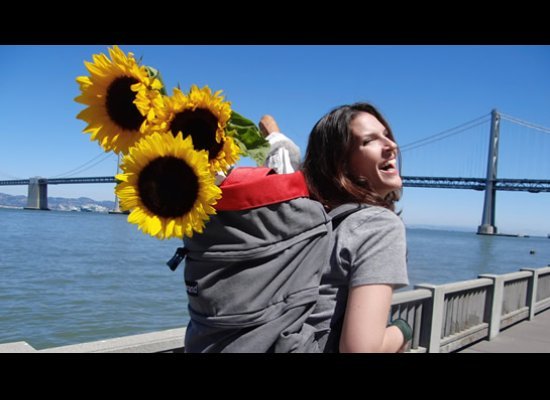 |
| Find out more about the Cornucopia Bag here. |
I wonder if I could put E. in the top and my food in the bottom?
Sunday, August 29, 2010


Thursday, August 26, 2010
1. Avoid Discouragement Revisited
Just a day or so after I posted about my work on avoiding discouragement we were going to go on a family walk after dinner. The twins wanted to pull their sleds (yes, snow sleds) to the local hill and ride down it. Plastic sleds on sidewalks and asphalt are loud and dragging them along scraping the bottom wears them out fairly quickly. So, I at first said no, we should leave the sleds home. I said they wouldn't go down the grassy hill very well. But I didn't resist fervently. Then I backed off a bit more because I really didn't care that much, I thought it was more of an annoyance. I told Twin M that he should ask his mother, who has more sensitive ears than I do.
She initially said no and offered to take the boys and the sleds to the hill in the morning after breakfast. That was the beginning of a meltdown. I thought a bit more about it and realized it really didn't matter much. Sure, it would be a bit noisy, but that's about it. As long as the twins were willing to take the sleds the whole way, there and back, why not? So, my significant other with sensitive ears and I agreed. The twins were happy and off we went.
Despite the small annoyance of sleds occasionally hitting our legs, the walk was fine. We got some curious looks from neighbors, but given the other oddities of our family, I suspect they weren't surprised. When we got to the hill, the twins sat on their sleds and asked for a push. I did what I could and was surprised at how well the sleds slid down the grass. It wasn't great. They stopped about 3/4 of the way down the hill, but the twins loved it. They loved it. Fun and hilarity ensued. They tried lying on their sleds as well as standing on them. They even let little E. ride with them.
The outing was an amazing success.
And all of this goes back to my original discouragement and the changing of my mind. I discouraged them because I didn't want to be inconvenienced with the noise and potential pulling of the sleds. I didn't want to have to argue about pulling them down the sidewalk in the sled or who-knows-what. As a member of the family and a participant in the walk, my opinion does matter. If it was going to be too big of an inconvenience, then no still would have been an acceptable answer. But it wasn't going to be too big of an inconvenience and all three boys had a great time. Avoiding discouragement is a learning process and I think we (I) do it all the time every day. I hope to do less of it so my boys will be able to explore and learn for themselves and so they can have more times like last night.
p.s. Even at the hill I had a small moment of discouragement. Twin J was standing on his sled trying to get it to start down the hill. He was on the flat part of the hill, so his sled was sliding nowhere. I told him he should move to the hill so he could slide down, which he did. Twin J is pretty bright, and I'm sure if I had said nothing, he would have learned that for himself and he would have moved his sled. Sure, this wasn't much discouragement, but I need to give my boys time to figure things out for themselves.
p.p.s. Why didn't I bring the camera?
She initially said no and offered to take the boys and the sleds to the hill in the morning after breakfast. That was the beginning of a meltdown. I thought a bit more about it and realized it really didn't matter much. Sure, it would be a bit noisy, but that's about it. As long as the twins were willing to take the sleds the whole way, there and back, why not? So, my significant other with sensitive ears and I agreed. The twins were happy and off we went.
Despite the small annoyance of sleds occasionally hitting our legs, the walk was fine. We got some curious looks from neighbors, but given the other oddities of our family, I suspect they weren't surprised. When we got to the hill, the twins sat on their sleds and asked for a push. I did what I could and was surprised at how well the sleds slid down the grass. It wasn't great. They stopped about 3/4 of the way down the hill, but the twins loved it. They loved it. Fun and hilarity ensued. They tried lying on their sleds as well as standing on them. They even let little E. ride with them.
The outing was an amazing success.
And all of this goes back to my original discouragement and the changing of my mind. I discouraged them because I didn't want to be inconvenienced with the noise and potential pulling of the sleds. I didn't want to have to argue about pulling them down the sidewalk in the sled or who-knows-what. As a member of the family and a participant in the walk, my opinion does matter. If it was going to be too big of an inconvenience, then no still would have been an acceptable answer. But it wasn't going to be too big of an inconvenience and all three boys had a great time. Avoiding discouragement is a learning process and I think we (I) do it all the time every day. I hope to do less of it so my boys will be able to explore and learn for themselves and so they can have more times like last night.
p.s. Even at the hill I had a small moment of discouragement. Twin J was standing on his sled trying to get it to start down the hill. He was on the flat part of the hill, so his sled was sliding nowhere. I told him he should move to the hill so he could slide down, which he did. Twin J is pretty bright, and I'm sure if I had said nothing, he would have learned that for himself and he would have moved his sled. Sure, this wasn't much discouragement, but I need to give my boys time to figure things out for themselves.
p.p.s. Why didn't I bring the camera?
Tuesday, August 24, 2010
Encouraging Our Children
I recently read Alyson Schafer's Honey, I Wrecked the Kids, and found it very thought provoking. I generally have a couple of reactions to these books. First, I am both disheartened and inspired. Despite what the books say about not worrying about the past and becoming a better parent, I always feel guilty for the mistakes I've made as a parent. I'm also inspired, because the books tend to be so heartening and hopeful. They make me hopeful that I can become a better parent.
Another one of my primary reactions is this: Oh, yea, you don't have twins. I have yet to read a book that adequately addresses twins. I've met people who try to liken their children, who may only be a year apart, to having twins. No way. Sure, there are challenges to raising kids close in age, but they aren't twins. If you've been around small children, the difference between a 2 and 3 year old is significant. Add the fact that twins have always been together -- even in utero. The connections I see in my twins are profound.
Back to Schafer's book. Near the end of the book, Schafer offers 19 ways we can encourage our children. I thought I would try and go through all 19 and see what I do or can do as I strive to become a better parent. So here we go.
1. Avoid discouragement
Schafer argues that one must put away praise (which she defines as different from encouragement) and punishment and be more encouraging. As she describes, this seems easy, but her examples point to something more insidious. One simple kind of discouragement parents do all the time is to discourage exploration or experimentation because we know it will result in failure. But failure is a valuable learning tool. If, as a parent, you've found yourself saying something, like, "Don't do that, it won't work. Do it this way." That is a form of discouragement. Of course there are times a parent must intervene, but correction before a child gets to experiment and learn discourages the child from experimenting.
So I find myself doing this, mostly for expediency. I want something done sooner than my sons can do it or I don't want to wait for the child to fail and then need my help. But if I want my sons to become more independent and able and willing to solve their own problems. I need to let them explore and learn for themselves, even through failure and frustration. And I can't get frustrated with their failure or frustration.
I have been working on this and improving. I still have a ways to go. I also think just less discouragement in the world is a good thing. And I'll start with my own family.
Another one of my primary reactions is this: Oh, yea, you don't have twins. I have yet to read a book that adequately addresses twins. I've met people who try to liken their children, who may only be a year apart, to having twins. No way. Sure, there are challenges to raising kids close in age, but they aren't twins. If you've been around small children, the difference between a 2 and 3 year old is significant. Add the fact that twins have always been together -- even in utero. The connections I see in my twins are profound.
Back to Schafer's book. Near the end of the book, Schafer offers 19 ways we can encourage our children. I thought I would try and go through all 19 and see what I do or can do as I strive to become a better parent. So here we go.
1. Avoid discouragement
Schafer argues that one must put away praise (which she defines as different from encouragement) and punishment and be more encouraging. As she describes, this seems easy, but her examples point to something more insidious. One simple kind of discouragement parents do all the time is to discourage exploration or experimentation because we know it will result in failure. But failure is a valuable learning tool. If, as a parent, you've found yourself saying something, like, "Don't do that, it won't work. Do it this way." That is a form of discouragement. Of course there are times a parent must intervene, but correction before a child gets to experiment and learn discourages the child from experimenting.
So I find myself doing this, mostly for expediency. I want something done sooner than my sons can do it or I don't want to wait for the child to fail and then need my help. But if I want my sons to become more independent and able and willing to solve their own problems. I need to let them explore and learn for themselves, even through failure and frustration. And I can't get frustrated with their failure or frustration.
I have been working on this and improving. I still have a ways to go. I also think just less discouragement in the world is a good thing. And I'll start with my own family.
Subscribe to:
Posts (Atom)